Gastric Balloon in Dubai
A temporary, non-surgical weight-loss aid. There are two ways to place one — with an endoscope, or by simply swallowing a capsule. Both work the same way once inside.
What is a gastric balloon?
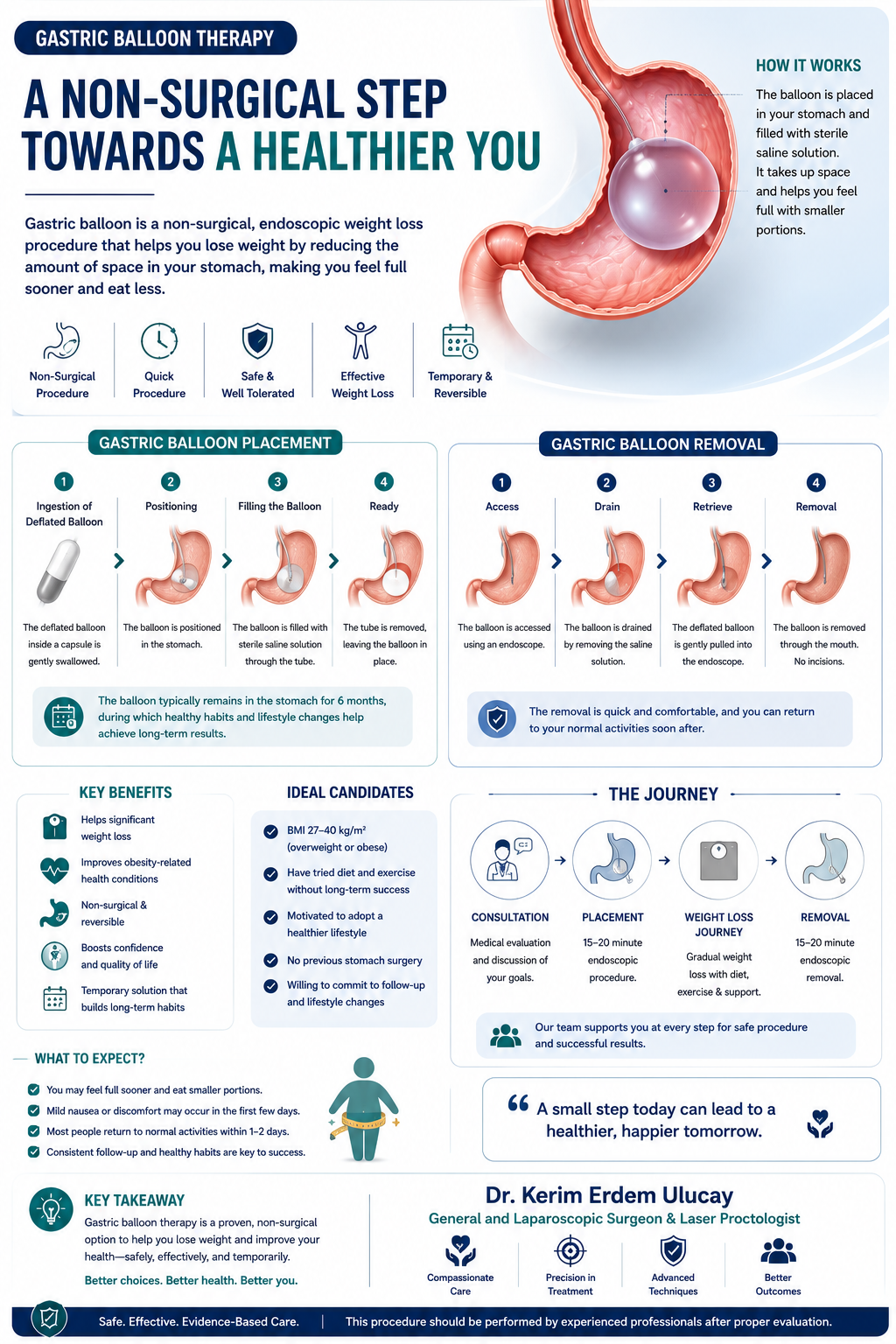
A soft silicone balloon sits inside your stomach and is filled with sterile fluid, taking up space so you feel full sooner and eat less at each meal. Nothing is cut, stapled or permanently altered. When the balloon period ends, the stomach returns to normal.
How does a gastric balloon work?
The mechanism is straightforward. A filled balloon occupies part of your stomach, so a smaller meal reaches the point where the stomach feels stretched — and stretch is the main signal your body uses to register fullness. You reach that point on less food.
There is a second effect that matters as much. A partly occupied stomach empties more slowly, so the feeling of fullness lasts longer between meals rather than fading after an hour. Together these reduce how much you eat without relying on willpower alone.
What it does not do is change appetite at a hormonal level. That is the difference between a balloon and weight loss injections such as semaglutide or tirzepatide, which act on appetite signalling in the brain. A balloon works mechanically; the injections work chemically. Both are legitimate approaches and they suit different people — and increasingly they are used in sequence rather than as rivals.
Two ways to place a balloon
This is the choice most patients care about, so it is worth being clear. The difference is entirely in how the balloon gets in and out — not in how it works once it is there.
Endoscopic Balloon
Placed through the mouth with an endoscope under light sedation, then removed the same way at the end of the period.
- In place for: 6 or 12 months — your choice
- Placement: 20–30 minutes under sedation
- Removal: a second short endoscopy
- Bonus: the endoscopy also checks your stomach for ulcers or hernia at the same time
Allurion Swallowable Balloon
You swallow a capsule containing the folded balloon. No endoscope, no sedation — and no removal procedure at all.
- In place for: approximately 16 weeks
- Placement: about 15 minutes, awake, in clinic
- Removal: none needed — it empties itself and passes naturally
- Suits: patients who want to avoid sedation or endoscopy entirely
Two separate decisions. How the balloon is placed (with or without gastroscopy) and how long it stays in (6 or 12 months) are chosen independently. The Allurion swallowable balloon is the exception — it has a fixed period of roughly 16 weeks by design.
How the Allurion balloon is placed
Because this is the option most people have not heard of, here is exactly what happens:
- You swallow a capsule attached to a very thin tube, with water.
- A quick X-ray confirms the capsule is sitting correctly in your stomach.
- The balloon is filled with around 550ml of fluid through the tube.
- A second X-ray confirms it has filled properly.
- The tube is gently withdrawn. You go home the same visit.
At roughly 16 weeks, a valve inside the balloon opens on its own. The balloon empties and passes naturally through the digestive system. Most people do not notice when it happens. In rare cases a balloon may need endoscopic removal, which is why this is done under proper medical supervision.
In rare cases the balloon may need endoscopic removal, which is why placement is done under proper medical supervision.
Who is a candidate?
Gastric balloons are generally considered for adults with a BMI between 27 and 40 who have not achieved lasting results through diet and exercise alone. For patients with a BMI above 50, a balloon can also be used as a bridge — reducing weight and surgical risk before a later bariatric operation.
Candidacy is confirmed in person. No online form can replace an examination.
Check your BMI
A quick indication of whether a balloon may be an option for you. This is a guide, not a diagnosis.
BMI is only one factor. Suitability also depends on your medical history, previous stomach surgery and an in-person examination. Some patients with a lower BMI and weight-related health conditions may still be candidates.
Contraindications — when a balloon is not appropriate
Being honest about who should not have this matters as much as who should. A balloon will not be placed if any of the following apply:
Absolute contraindications
- Previous stomach surgery (sleeve gastrectomy, bypass, fundoplication)
- Large hiatal hernia (generally over 5cm)
- Active stomach or duodenal ulcers, or significant erosions
- Pregnancy, or planning pregnancy during the balloon period
- Known gastrointestinal malignancy
- Severe inflammatory bowel disease or prior bowel obstruction
- Alcohol or drug dependency
Requires careful assessment first
- Blood-thinning medication (anticoagulants)
- Untreated eating disorders
- Long-term NSAID or aspirin use
- Uncontrolled psychiatric illness affecting follow-up
- Severe uncontrolled reflux
These are checked before anything is placed — for endoscopic balloons during the same endoscopy, and for the Allurion balloon through history, examination and investigation as needed.
Recovery: the first week
Days 1–3: The hardest stretch. Nausea, cramping and a strong feeling of fullness are expected while the stomach adjusts. Anti-nausea and antispasmodic medication is provided.
Days 4–7: Symptoms ease considerably. Most patients feel settled within the first week.
Week 2 onward: Diet progresses from liquids to pureed food to a structured eating plan, with regular follow-up.
Expected results
Published clinical studies report average weight loss of roughly 10–15% of total body weight over the balloon period. For the Allurion balloon specifically, multicentre studies report around 14% total body weight loss over the 16 weeks. These are population averages from published research, not outcomes tracked at this practice.
Risks
Serious complications are uncommon but real: persistent nausea occasionally requiring early removal, balloon deflation with possible migration, and rarely ulceration. Fluid-filled balloons are mixed with a blue dye so that if deflation occurs, it shows as blue-tinted urine — an early warning to contact the clinic immediately.
Cost & payment
Gastric balloon treatment across the UAE is a self-funded (cash) procedure — the price is not generally covered by UAE health insurance, as it is classified as an elective weight-loss treatment. Pricing varies by balloon type and what is included. We work to offer competitive, transparent pricing — contact us for a current quote for your situation.